Spottswood v. Dandridge
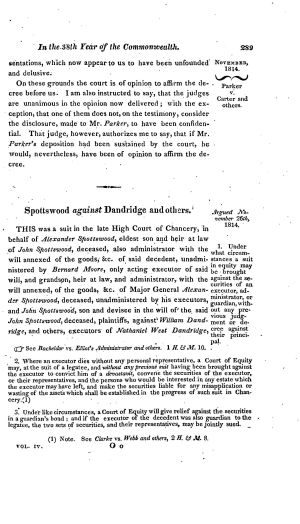
Spottswood v. Dandridge, 18 Va. (4 Munf.) 289 (1814),[1] was a case involving a suit against securities of executor. The case Spotswood v. Dandridge (different spelling) also involved the estate of Major General Alexander Spotswood, focusing on the distribution of slaves.
Background
Major General Alexander Spottswood appointed Bernard Moore as the administrator his estate, as well as the guardian to his two sons. Moore appointed several securities to make sure he faithfully carried out his duties as administrator, with one of them being Nathaniel West Dandridge. However, Moore greatly squandered the estate, leaving most of it unadministered. The court appointed Alexander Spottswood, son of John and grandson of the Major General, to administer the estate after Moore's death. Alexander sued William Dandridge, executor of Nathaniel West's estate, along with the other securities of Moore in the High Court of Chancery, holding them liable for Moore's maladministration. The securities demurred, arguing that Moore's death had discharged their liability.
The Court's Decision
On October 4, 1793, Chancellor Wythe overruled the demurrers and directed an account be taken by a commissioner. However, on March 13, 1803, Wythe permitted the demurrer to be re-argued and retracted his previous opinion, ultimately dismissing the case with costs.
The case was appealed to a special Court of Appeals who reversed Wythe’s decision, overruled the demurrers and remanded the case. The Court of Appeals found that the duties of the securities did not abate upon death, and they could still be held liable for Moore's maladministration. The Court also found that the High Court of Chancery had jurisdiction where an executor dies without any personal representative and a legatee brings suit against his securities to convict him of devastavit, because "[n]ot to afford relief in such case, would be to leave a right without a remedy.”
See also
References
- ↑ William Munford, Reports of Cases Argued and Determined in the Supreme Court of Appeals of Virginia, (Philadelphia: J. Webster, 1817.), 4:139.