Spotswood v. Dandridge
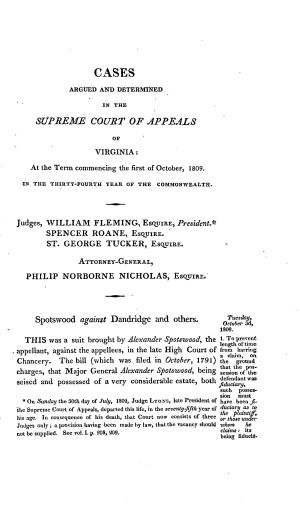
Spotswood v. Dandridge, 14 Va. (4 Hen. & M.) 139 (1809),[1] was a case involving slavery and claims against an estate. The case Spottswood v. Dandridge (different spelling) also involved the estate of Major General Alexander Spotswood, focusing on the maladministration of the executor, Bernard Moore.
Background
In his will, Major General Alexander Spotswood devised both his real and personal property to his son, John Spotswood, in fee tail male (to passed down to the male lineage of the family) The estate contained numerous slaves, and after Alexander's death, John gave a slave named Molly to his sister Dorothea. When it was discovered that Molly was pregnant, John took her back and gave his sister another slave named Mary Ann.
After John died, Dorothea's husband, Nathaniel West Dandridge, requested that John's estate give him Molly and all of her descendants. He received an order from the executor of Alexander’s estate, Bernard Moore, directing that Molly to be given to him. The order also allowed him to retain possession of Mary Ann and all of her children, who were distributed amongst various members of the Dandridge family.
When Nathaniel died, John's son brought suit against the executors of Dandridge's estate in Richmond District Court for recovery of Mary Ann and her children. He received a favorable judgment and was delivered Mary Ann and some of her children, but complained that he received no satisfaction for their hires as he was promised, and that that several of the descendants were not identified. As a result, he appealed the case to the High Court of Chancery, demanding discovery, a decree for the slaves and their profits, and for general relief.
The Court's Decision
Chancellor Wythe dismissed the case with court costs. The Court of Appeals affirmed the decree. The Court found that Nathaniel West Dandrige was acting as a fiduciary in holding the slaves for John Spotswood and his estate. However, there were nearly five years of adverse possession by Dandridge, creating an absolute bar to the plaintiff's title and justifying the case's dismissal.
See also
References
- ↑ William Hening and William Munford, Reports of Cases Argued and Determined in the Supreme Court of Appeals of Virginia: With Select Cases, Relating Chiefly to Points of Practice, Decided by the Superior Court of Chancery for the Richmond District, 3rd ed., ed. Lucian Minor. (New York: I. Riley, 1810.), 4:139.