Stockton v. Cook
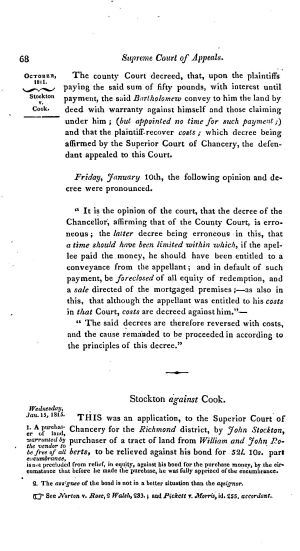
Stockton v. Cook, 17 Va. (3 Munf.) 68 (1811),[1] was a case involving a dispute involving an encumbrance upon land.
Background
John Stockton purchased a tract of land from William and John Roberts. At the time of the sale, William and John assured in their purchase agreement that the land was “clear of any fraud or deceit… [and] free and clear… from all manner of encumbrances.” To purchase the land, John Stockton advertised his bond to which Harman Cook bought for £5. However, a previous mortgage for £64 British debt remained on the land at the time of sale. John sued in the High Court of Chancery to be relieved from £52 he used to purchase land. John argued that because the sellers of the land were fraudulent he should be released from any obligation to repay the purchase price. Two witnesses testified that John Stockton was aware of the mortgage prior to purchase.
The Court's Decision
On September 21, 1803, Chancellor Wythe dismissed the case. However, in October Stockton filed a bill of review and requested Wythe reevaluate the case based on new facts. Chancellor Wythe found no reason to alter his decree and reaffirmed his prior decree. The Court of Appeals reversed the case and made the injunction perpetual.
In his dissent, Judge Fleming agreed with Chancellor Wythe in that Stockton’s prayer for relief did not have an equitable remedy. Judge Fleming stated “Whenever I have the misfortune to differ in opinion form the majority of the Court, I feel great dissidence in my own judgment; though in the case before us, I have the consolation to reflect that I concur with the venerable Judge who pronounced the decree, and is now no more.”
See also
References
- ↑ William Munford, Reports of Cases Argued and Determined in the Court of Appeals of Virginia, (New York: I. Riley, 1816), 3:68.