Stephens v. Cobun
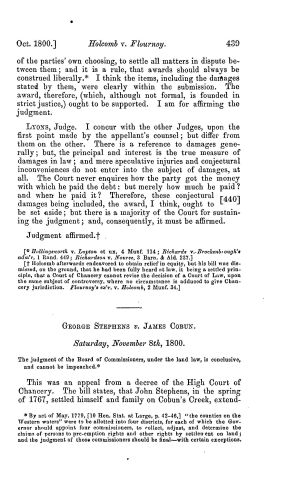
Stephens v. Cobun, 6 Va. (2 Call) 440 (1800),[1] was a case were the Court determined whether a judgment by the Board of Commissioners concerning land law could be impeached.
Background
In the spring of 1767, John Stephens and his family settled on Cobun’s Creek. John Stephens and Jonathan Cobun agreed to establish a property line between the two families which included 400 acres down the creek. John built a house on the land and cleared ten acres of land to raise a crop. For four years the boundary line between John and Jonathan went undisputed. However, five years after John's death, John’s widow sold the land back to Jonathan Cobun, who later sold it to the defendant, James Cobun. George Stephens, John Stephens's son, was a minor at the time of the sale. George's mother left him and he lived off the support of his friends. Henry Stephens, George's adult representative, informed the Board of Commissioners of George's claim in the property. Henry argued that since George was a "poor and ignorant" minor, who could not assert his claims and the time of sale and did not have money to support his claim against James. Adding to the controversy was an individual, Workman, whom Cobun claims first developed the land, making Stephens an intruder with no valid title in the first place (although the evidentiary record is unclear on the extent to which Workman actually developed the land or was just there as a hunter). Henry prayed the court to order James Cobun to convey the land and give George any additional relief.
The Court's Decision
The County Court found in favor of George Stephens. Chancellor Wythe reversed the conveyance stating that the Stephens's ancestor had no title and that the judgment of the commissioners was final. The Court of Appeals affirmed Chancellor Wythe’s decision.
See also
References
- ↑ Daniel Call, Reports of Cases Argued and Adjudged in the Court of Appeals of Virginia, 3rd ed., ed. Lucian Minor (Richmond: A. Morris, 1854), 2:371. George Wythe owned the first edition of this set.