Smith v. Chapman
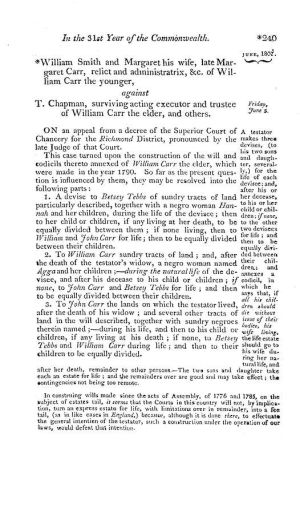
Smith v. Chapman, 11 Va. (1 Hen. & M.) 240 (1807),[1] is a case where the Court interprets a will in order to determine whether a remarried daughter-in-law can take dower from the estate.
Background
A complicated will where a daughter-in-law’s second husband, William Smith brings a case in Chancery Court on behalf of his wife to claim dower from the inherited estate of her first husband, William Carr the younger. The testator, William Carr the elder, had a will leaving land and slaves to his sons, John Carr and William Carr, and his daughter, Betsey Tebbs. In a codicil, he stated that if his children died "without issue of their bodies," his wife, if she was still alive, would earn a life estate. The Chapman family was also bequeathed half of the estate in this codicil.
William Carr's portion of the will stated that he would receive land and slaves "during the natural life of the devisee, and after his decease to his child or children; if none, to John Carr and Betsey Tebbs for life; and then to be equally divided between their children.” He would then die without any children, leaving behind a widower who remarried William Smith. Smith then sued in the Court of Chancery trying to collect dower in the lands which had been devised to his wife.
The Court's Decision
Chancellor Wythe dismissed the case and the plaintiffs appealed, calling for a construction of the will. The key question was whether William Carr had acquired a fee estate in the will, or a mere life estate. The former would entitle his wife to a dower, and the latter would not. Smith's counsel argued that an implied fee tail had been created because there was a general intent of preserving the estate for the family line. Under the Acts of Assembly of 1776 and 1785, the fee tail would then convert to a fee simple estate, and go to William Carr's widow. Chapman's counsel argued that the intent of the testator to create a life estate for William Carr was clear, and furthermore that a feel tail cannot be created by implication but only by explicit language. Both parties exhaustively reviewed the case law on this subject in making their arguments. They also dedicated significant time to discussing whether the terms "children" and "issue" were interchangeable terms.
The Court of Appeals affirmed Chancellor Wythe’s decision to dismiss the case, finding clear intent that the testator wanted to provide equally for his children by giving them a life estate with contigent remainders should they fail to have children of their own. The Court also found that after the Acts of Assembly, a feel tail could not be created by implication but rather only by clear and unequivocal words, which were absent here. Ultimately, taking into context the entire will and the testator's intent, the Court found that William Carr took only a life estate, and therefore his widow and William Smith could not take a dower.
See also
References
- ↑ William Hening and William Munford, Reports of Cases Argued and Determined in the Supreme Court of Appeals of Virginia: With Select Cases, Relating Chiefly to Points of Practice, Decided by the Superior Court of Chancery for the Richmond District, 3rd ed., ed. Lucian Minor. (Flatbush (N.Y.): I. Riley, 1809.), 1:240.