Scott's Ex'rs v. Trents
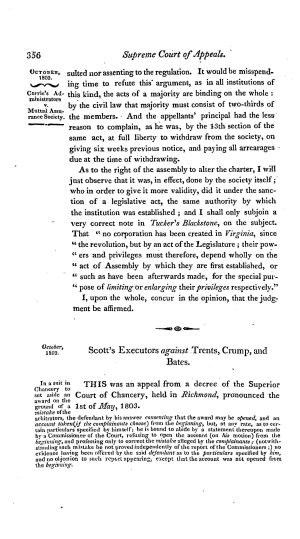
Scott's Ex'rs v. Trents, 14 Va. (4 Hen. & M.) 356 (1809),[1] was a case involving a mistake by arbitrators.
Background
John Scott entered into an agreement with Trents, Crump, and Bates on April 19th, 1792. The agreement stated that various balances owed to Scott by members of the Trent family could be applied to his debts with Trents, Crump, and Bates. The matter was referred to arbitrators, who examined the accounts between the parties and found an amount due from Scott to Trents, Crump, and Bates was balanced by a sum given to Scott by Peterfield Trent. Trents, Crump, and Bates tried to set aside the award, claiming the arbitrators had made a mistake. They took the case to the High Court of Chancery, where Scott insisted that all accounts had been made with with the consent of the plaintiffs. However, Scott consented to re-opening the award and re-examining the accounts, after which he died and his executors revived the suit.
The Court's Decision
Chancellor Wythe allowed the re-opening of the account, at which point it was found Scott owed more than had been previously calculated. The Court of Chancery then entered a decree against Scott. His executors appealed. The Court of Appeals affirmed Wythe’s decree. It found that while it would not have disturbed the award of the arbitrators, Scott's own consent to re-opening the award amounted to a waiver of his legal advantage.
Trents, Crump, and Bates also argued that they should be awarded interest upon the debt accruing since the Court of Chancery issued its decree, relying on Deanes v. Scriba. The Court of Appeals refused, citing to differences between a reversal of the Court of Chancery (as was the case in Deanes) and an affirmance (as was the case here).
See also
References
- ↑ William Hening and William Munford, Reports of Cases Argued and Determined in the Supreme Court of Appeals of Virginia: With Select Cases, Relating Chiefly to Points of Practice, (New York: I. Riley, 1811.), 14:356.