Scott's Ex'r v. Osborne's Ex'r
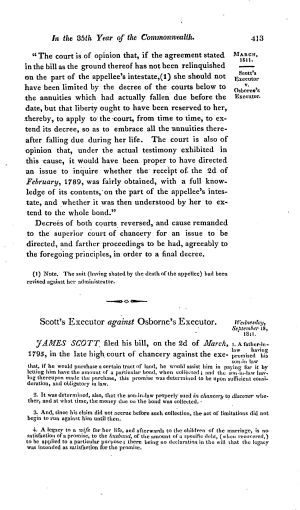
Scott's Ex'r v. Osborne's Ex'r, 16 Va. (2 Munf.) 413 (1811),[1] was a case involving a will dispute over land.
Background
James Scott was the son-in-law of William Osborne, having married his daughter, Elizabeth. Scott intended to buy some land from Robert Donald in Prince Edward County and was encouraged to do so by Osborne, who promised he would pay part of it. Osborne intended to pay using a debt collected from Henry Anderson, but was unable to collect it, leaving Scott to pay for the land in its entirety. When Osborne died, he left a small amount in his will to Elizabeth, along with a number of slaves. There was also evidence that he did, at some point, collect the debt from Anderson, although it was never paid to Scott. As a result, Scott sued in the High Court of Chancery to induce Osborne's executors to pay him the amount recovered from Anderson.
The Court's Decision
Chancellor Wythe dismissed the bill with costs. The case was appealed and then revived by the executors after both appellant and appellee passed away.
The Court of Appeals reversed the Wythe’s ruling. The Court found that the bill was necessary to discover whether and when the debt had been recovered from Anderson, because the statute of limitations on the claim would not run until Osborne received the money from Anderson. The Court also held that the executors of Osborne’s estate were to pay Scott’s estate the full cost of the debt recovered from Anderson, as well as interest starting from the date the debt was received by Osborne.
See also
References
- ↑ William Munford, Reports of Cases Argued and Determined in the Supreme Court of Appeals of Virginia, (New York: I. Riley, 1814.), 2:413.