Robertson v. Campbell
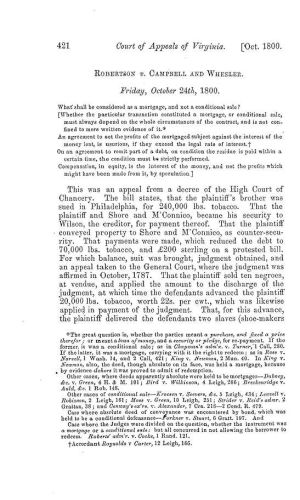
Robertson v. Campbell, 6 Va. (2 Call) 421 (1800),[1] was a case involving whether a conveyance of slaves was a mortgage or a conditional sale.
Background
Robertson’s brother was sued by Wilson, a creditor in Philadelphia, for 240,000 lbs of tobacco. In order to pay the debt, Robertson, Shore, and M’Connico became surety to Wilson. Campbell and Wheeler advanced 20,000 lbs of tobacco to Roberts, and in return he gave them four slaves - two shoemakers and a woman and her child. When the original creditor, Wilson, tried to remit the damages against Roberts, Campbell and Wheeler refused to accept this and demanded an account be taken of what was due. The parties took the case to the Court of Chancery, where they disagreed over whether the conveyance was a mortgage or a conditional sale.
The Court's Decision
Chancellor Wythe decreed in favor of Campbell and Robertson appealed. The Court of Appeals reversed the decree, finding that the conveyance was a mortgage rather than a conditional sale, citing to Chapman's Adm'x v. Turner. The Court held that the slaves were intended to be security for the loan of 20,000 lbs of tobacco, rather than a permanent sale, and once their profits had discharged the interest, they should be returned to Roberts. The Court also held that the contract was usurious and void because the slaves' profits exceeded the legal rate of interest.
See also
References
- ↑ Daniel Call, Reports of Cases Argued and Adjudged in the Court of Appeals of Virginia, (Richmond: R. I. Smith, 1833), 5:115. George Wythe owned the first edition of this set.