Roberts's Widow v. Stanton
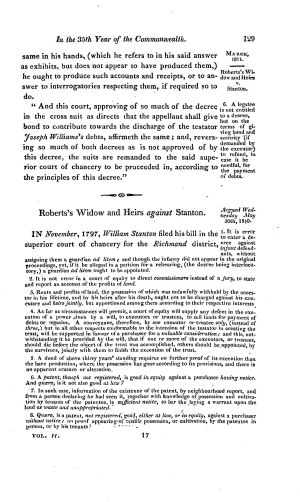
Roberts's Widow v. Stanton, 16 Va. (2 Munf.) 129 (1811),[1] was a case involving appointment of a guardian ad litem.
Background
In November 1797, William Stanton sued Wilson Miles Cary, the executor of the estate of George William Fairfax, regarding Stanton's purchase of land in Culpeper County. The land, purchased in or about 1791, was part of Fairfax's estate, which under his will was supposed to be sold by his executors. Cary was the only acting executor in the country and his agent sold the land and procured a deed to be made only by Cary. However, Joseph Roberts surveyed the land and found it to have imperfect title, at which point the Commonwealth granted the land to him. Stanton brought suit and when Roberts died, it abated to Sarah Roberts and her eight children, who were Roberts's heirs at law.
The Court's Decision
The Richmond Court of Chancery found for Stanton and ordered Sarah Roberts to give him possession of the land along with costs. She submitted a bill of review to Chancellor Wythe, claiming that several of the defendants were infants and therefore should have been appointed a guardian ad litem. Chancellor Wythe confirmed his former ruling, and she appealed. The Court of Appeals reversed and annulled Wythe’s ruling, finding that a guardian ad litem should have been appointed for the infant defendants. The validity of Cary's conveyance was also questioned, and so the Court ruled that upon remand the residuary legatees of Fairfax's estate be added as parties.
See also
References
- ↑ Daniel Call, Reports of Cases Argued and Determined in the Supreme Court of Appeals of Virginia, (New York: I. Riley, 1814), 2:129.