Price v. Campbell (1804)
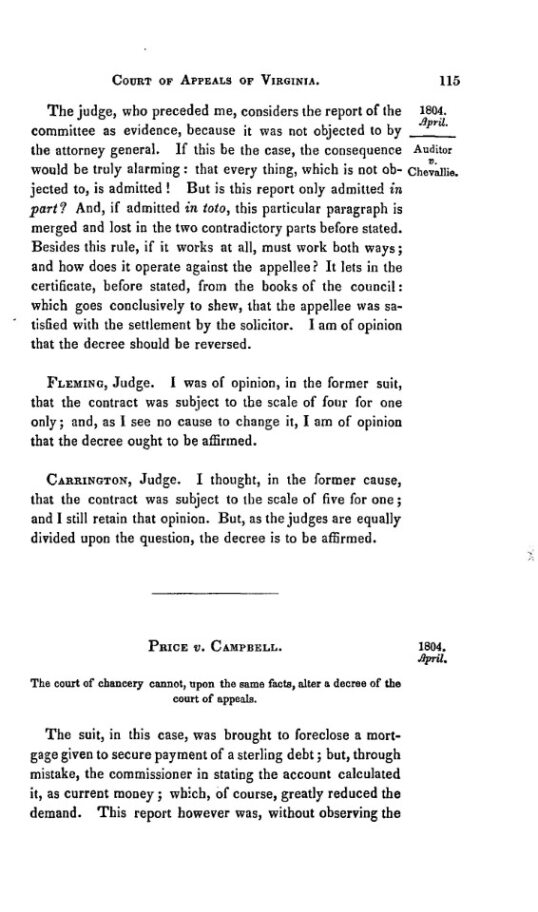
Price v. Campbell, 9 Va. (5 Call) 115 (1804),[1] was a case involving the question of whether or not a court of chancery could, upon the same facts, change a decree of the Court of Appeals.
Background
The Court of Appeals affirmed a judgment for a plaintiff mortgagee when trying to foreclose on a mortgage. When the case went back down the trial court, a mistake in the calculation of the account was discovered and corrected, and the corrected decree was appealed again.
The Court's Decision
On appeal, the Court considered whether the Chancellor could, upon the same facts, change the decree of the Court of Appeals. The Court cited to White v. Atkinson and found that he could not. Even though the mistake had gone unnoticed when affirming the decree, it did not make a difference, because the point was already fairly decided. To allow the court of chancery to alter decrees affirmed by the Court of Appeals would create perpetual controversies contrary to the doctrine of interest reipublicae res judicatas non rescindi. As a result, the Court of Appeals reversed the decree.
See also
References
- ↑ Daniel Call, Reports of Cases Argued and Decided in the Court of Appeals of Virginia, (Richmond: R. I. Smith, 1833), 5:115.