Payne v. Dudley
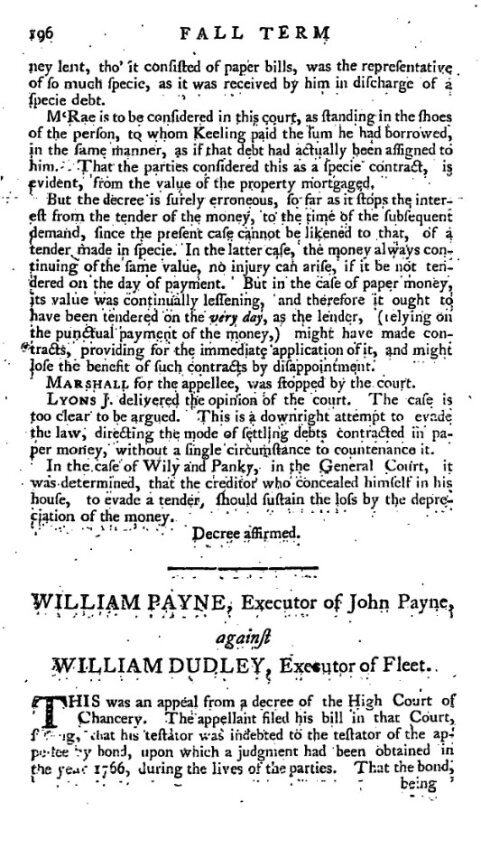
Payne v. Dudley, 1 Va. (1 Wash.) 196 (1793),[1] was a debtor/creditor case.
Background
Payne, John Payne’s executor, sued in the High Court of Chancery stating that John Payne owed a debt to Fleet who obtained a judgement against John in 1766. William Dudley, Fleet’s executor, was looking through his papers and found the same bond against John Payne. William Dudley then sued in a different court than the one the original judgement was obtained. William Payne was unaware of this second proceeding and could not plead at bar, thus a second judgment was made against John Payne in 1789. William Payne sued William Dudley in the High Court of Chancery to obtain relief from the second judgment. William Payne argued that in 1766 John Payne gave a large part of his property to John Semple to the pay the debt in questions, thus the debt was satisfied. In his answer, William Dudley denied any knowledge of the 1766 judgment or that the debt had been satisfied.
The Court's Decision
Since the 1766 judgment was based solely on William Payne’s confession, Chancellor Wythe dismissed the case with the belief that the equity sought was not admitted by the answer and not supported by evidence. The Court of Appeals affirmed the decision.
See also
References
- ↑ Bushrod Washington, Reports of Cases Argued and Determined in the Court of Appeals of Virginia, (Richmond: T. Nicolson, 1798), 1:196.