Norton v. Rose
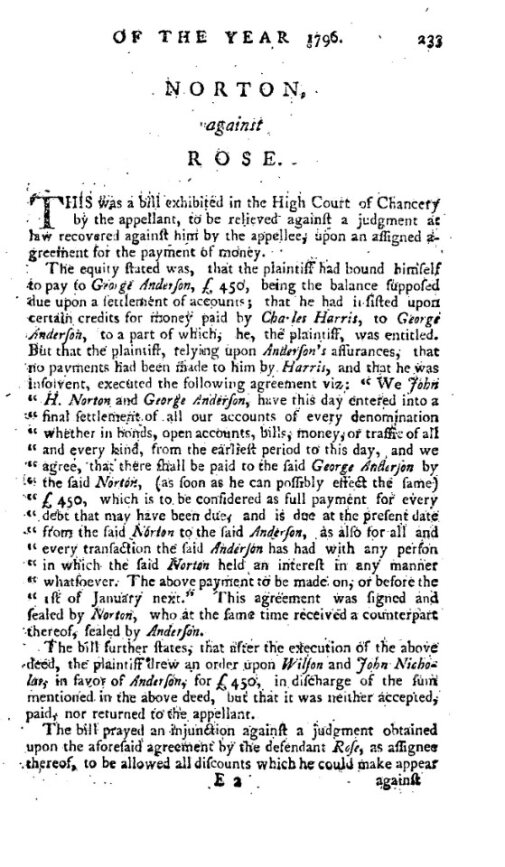
Norton v. Rose, 2 Va. (2 Wash.) 233 (1796),[1] was a case asking whether a bond, in the hands of an assignee without notice, is discharged of the original equity existing against it.
Background
Norton promised to pay George Anderson £450 to settle a debt. Charles Harris owed money to both Norton and Anderson. Norton attempted to claim a credit for the proceeds of a quantity of goods, which were in the hands of Harris, and which he wanted to apply to his debt to Anderson. However, both Harris and Anderson claimed that no money had been paid, and that Harris was insolvent. Anderson and Norton then drew up an agreement for payment, and Anderson assigned his bond to Rose, who purchased it for valuable consideration. Rose was a bonafide purchaser who did not make an inquiry into whether or not any equity attached to the bond. Norton brought this case against Rose and Anderson, attempting to discount his debt against Anderson.
The Court's Decision
Chancellor Wythe dismissed the case against Rose. However, since Anderson failed to respond in Court to Norton’s complainant, Wythe gave a default judgment to Anderson. On Norton’s appeal to the Court of Appeals, the Court considered the Virginia Act of Assembly of 1748, which allowed bonds to be assigned and permitted all discounts that the defendant could prove. In England, equity does not follow bills of exchange, because they are intended as a form of currency passing money from one country to another, and allowing equity to follow would make commerce considerably more difficult. However, the Court found that in Virginia, the legislature explicitly distinguished between bills of exchange and bonds in the Act of 1748. Bonds are intended to more easily settle debts, and they rarely ever leave the country or even the neighborhood where they were first circulated. Therefore, the equity of a debt does follow the assignee of a bond or obligation. The Court found as a result that Norton should be allowed to set off and discount against the debt claimed by Rose. The Court reversed Wythe’s decision and remanded the case back to the High Court of Chancery for further proceedings.
See also
References
- ↑ Daniel Call, Reports of Cases Argued and Determined in the Court of Appeals of Virginia, (Richmond: T. Nicolson, 1799), 3:482.