Mayo v. Bentley
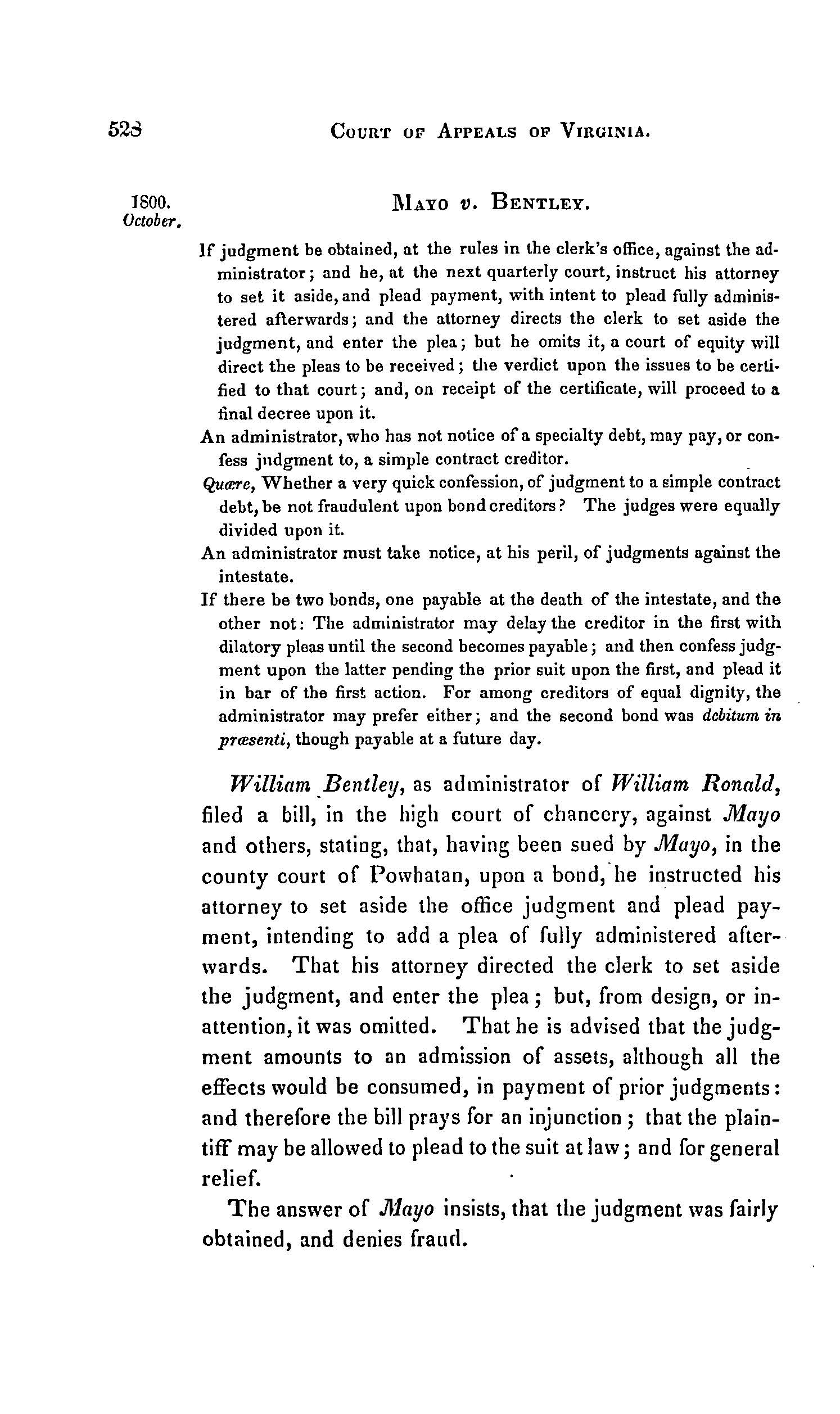
Mayo v. Bentley, 8 Va. (4 Call) 528 (1800),[1] was a case where the Court determined whether the administrator of an estate could pay a simple contract creditor before a bond creditor.
Background
William Ronald died on February 3rd, 1793, and William Bentley was appointed administrator of his estate on February 21st by the county court of Powhatan. The decedent died intestate, and his estate was apparently burdened by numerous debts. On February 26th, Andrew Ronald, the decedent's brother and a simple contract creditor of the estate, instituted a suit against Bentley in the county court of Henrico. Two days later, on February 28th, Mayo, a specialty creditor of the estate, issued his own writ upon the bond, from the county court of Powhatan. On March 4th, Bentley confessed judgment to Ronald and paid his debt. When he was served with notice of Mayo's writ, he obtained a judgment from the Powhatan court that it was to be set aside. However, this was not done due to an omission of the clerk, and because Bentley did not have assets to pay both Ronald and Mayo, he sought an injunction from the High Court of Chancery.
The Court's Decision
Chancellor Wythe of the High Court of Chancery found that Bentley had no notice of Mayo's writ when he confessed judgment to Ronald, and furthermore that an administrator can favor some creditors to the detriment of others. As a result, the court ruled in Bentley's favor. Mayo appealed this decision to the Court of Appeals, where the Court reversed the decree in part and affirmed in part. The Court found that it would be "an unusual severity" to charge Mayo with costs, when he was guilty of no fault and filed his claim against Bentley in a timely manner. The Court also identifies three types of debts: judgments made against the intestate during his lifetime, specialty debts, and simple contract claims. Judgments must be paid first, and the administrator must take notice of them because they are a matter of record. Specialty debts must be paid second, although they require timely notice to the administrator. Simple contract debts must be paid last, although if there is no notice, then an administrator may pay them before specialty debts, and suffer no harm. The Court also finds that administrators can only have preferences between creditors of the same grade; however, superior creditors must be given preference over inferior creditors. Here, because Mayo was a specialty creditor, he was entitled to payment before Ronald, a simple contract creditor. There is some disagreement between judges over whether or not Bentley had sufficient notice of Mayo's claim, and some judges even allege fraud on Bentley's part. Due to the division between the judges, the Court upheld the payment as well as the injunction requested by Bentley. However, the Court directed the parties to have a commissioner enquire into the fairness if the debt, and for Bentley to pay Mayo the costs of the appeal.
See also
References
- ↑ Daniel Call, Reports of Cases Argued and Decided in the Court of Appeals of Virginia, (Richmond: R. I. Smith, 1833), 4:528.