Price v. Campbell (1799)
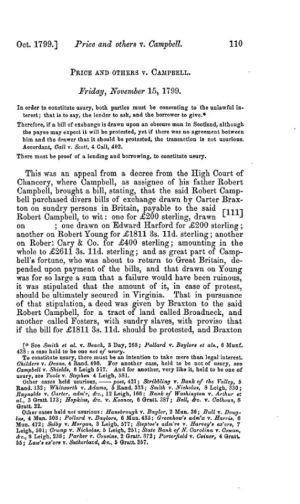
Price v. Campbell, 6 Va. (2 Call) 110 (1799),[1] was a case involving a bill of exchange and whether or not it was usurious.
Background
Campbell was the assignee of his father Robert, who had numerous debtors in England, making up a large part of Campbell’s fortune. A deed was given to Robert by a man named Braxton. It promised a tract of land called Broadneck and some slaves, in case the bill was protested, but the deed would be void if Braxton paid him back. Robert wanted to further secure the amount of money, so he engaged with Brooke and Page as securities for whatever Braxton might owe him. Ultimately, Price was the executor for several of Robert's creditors, who was sued along with Braxton by Campbell to sell the lands and the slaves to satisfy his claim.
The Court's Decision
Chancellor Wythe ruled against Braxton and Price and decreed a payment of £2498 with a 10% interest rate to the time of the decree. He further decreed that in the event of default, the slaves would be sold and if that is insufficient the administrators of both Brooke and Page would pay the balance. Price, Braxton, and the other defendants appealed. The Court of Appeals found no usury in the original contract, because it was a sale of bonds rather than a loan (as is required for usury). It also found that the claim was not barred by the statute of limitations as claimed by appellants. As a result, the Court of Appeals affirmed Wythe’s decision. Later, it was discovered that a mistake had been made in the decree, where the monetary judgment was declared in dollars, rather than sterling. The plaintiff's request to correct the decree is covered in Campbell v. Price.
See also
References
- ↑ Daniel Call, Reports of Cases Argued and Adjudged in the Court of Appeals of Virginia, 3rd ed., ed. Lucian Minor (Richmond: A. Morris, 1854), 5:92. George Wythe owned the first edition of this set.