Clarke v. Conn: Difference between revisions
Jump to navigation
Jump to search
Created page with "{{DISPLAYTITLE:''Clarke v. Conn''}} File:MunfordsReports1812V1ClarkevConn.pdf|link=Media:MunfordsReports1812V1ClarkevConn.pdf|thumb|right|300px|First page of the opinion [[M..." |
Mvanwicklin (talk | contribs) mNo edit summary |
||
| (4 intermediate revisions by 4 users not shown) | |||
| Line 1: | Line 1: | ||
{{DISPLAYTITLE:''Clarke v. Conn''}} | {{DISPLAYTITLE:''Clarke v. Conn''}} | ||
[[File: | [[File:MunfordClarkevConn1812v1p160.jpg|link={{filepath:MunfordsReports1812V1ClarkevConn.pdf}}|thumb|right|300px|First page of the opinion [[Media:MunfordsReports1812V1ClarkevConn.pdf|''Clarke v. Conn'']], in [http://wm-primo.hosted.exlibrisgroup.com/01COWM_WM:EVERYTHING:01COWM_WM_ALMA21560678820003196 ''Reports of Cases Argued and Determined in the Supreme Court of Appeals of Virginia''], by William Munford. New York: I. Riley, 1812.]] | ||
__NOTOC__ | __NOTOC__ | ||
[[Media:MunfordsReports1812V1ClarkevConn.pdf|''Clarke v. Conn'']], | [[Media:MunfordsReports1812V1ClarkevConn.pdf|''Clarke v. Conn'']], 15 Va. (1 Munf.) 160 (1810),<ref>William Munford, ''Reports of Cases Argued and Determined in the Supreme Court of Appeals of Virginia,'' (New York: I. Riley, 1812), 1:160.</ref> was a case where the Court of Appeals determined whether it had jurisdiction to hear a plea. | ||
==Background== | ==Background== | ||
Chancellor Wythe dismissed the original case with court costs. However, the plaintiff sought an appeal which required a security be paid to the court clerk. The plaintiff failed to make that deadline but a motion was granted by the court to allow the plaintiff to submit his bond and security at a later date. After the appeal was docketed for almost 5 years, the defendant submitted a motion dismissing the case for being improvidently (mistakenly, misleadingly) granted. | Chancellor Wythe dismissed the original case with court costs. However, the plaintiff sought an appeal which required a security be paid to the court clerk. The plaintiff failed to make that deadline but a motion was granted by the court to allow the plaintiff to submit his bond and security at a later date. After the appeal was docketed for almost 5 years, the defendant submitted a motion dismissing the case for being improvidently (mistakenly, misleadingly) granted. | ||
===The Court's Decision=== | ===The Court's Decision=== | ||
After a hard deliberation, the Court of Appeals also dismissed the case for lack of jurisdiction. | After a hard deliberation, the Court of Appeals also dismissed the case for lack of jurisdiction. | ||
==See also== | ==See also== | ||
*[[Wythe's Judicial Career]] | *[[Wythe's Judicial Career]] | ||
| Line 13: | Line 15: | ||
==References== | ==References== | ||
<references/> | <references/> | ||
[[Category: Cases]] | [[Category: Cases]] | ||
[[Category: Procedure]] | |||
Latest revision as of 18:44, 30 July 2018
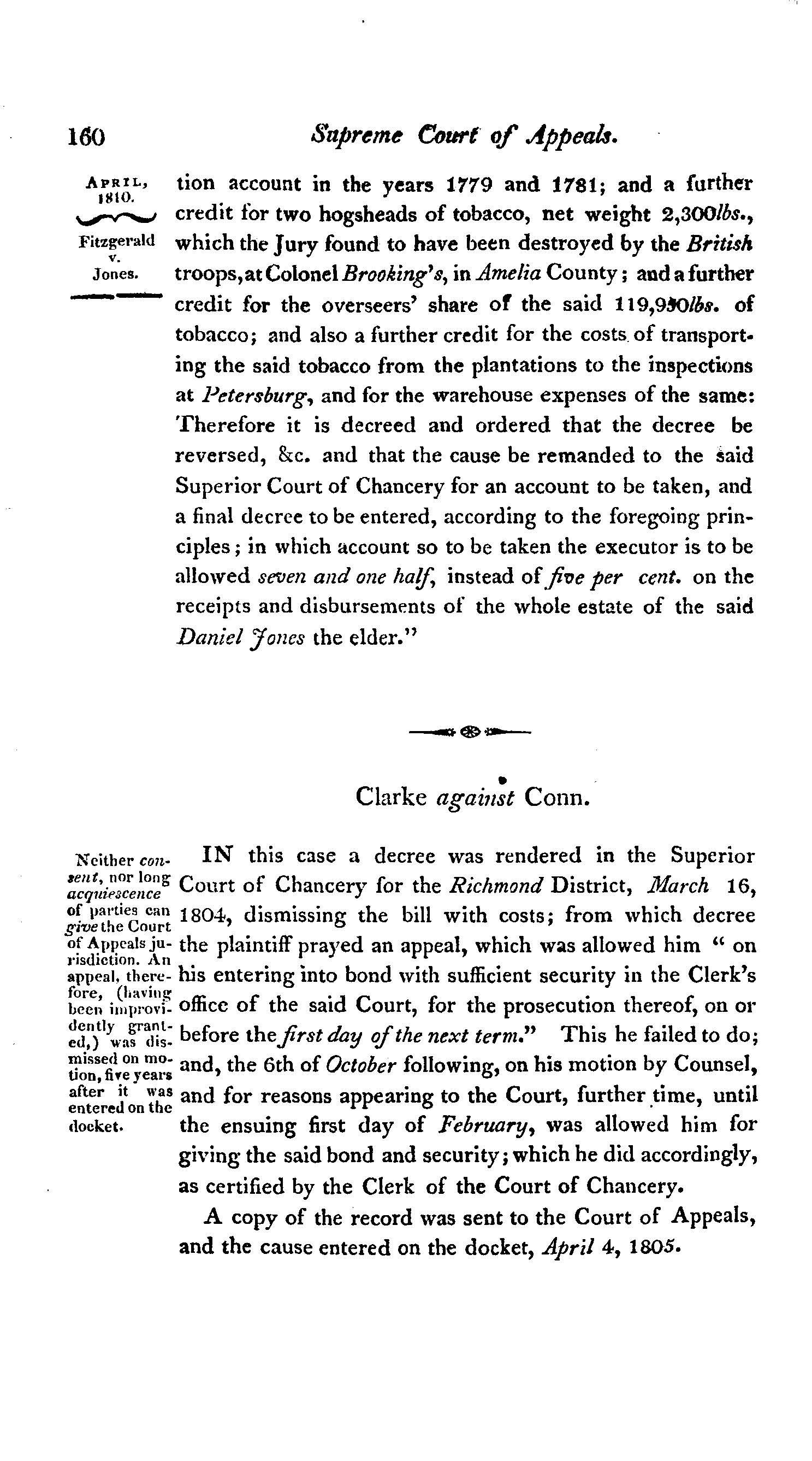
Clarke v. Conn, 15 Va. (1 Munf.) 160 (1810),[1] was a case where the Court of Appeals determined whether it had jurisdiction to hear a plea.
Background
Chancellor Wythe dismissed the original case with court costs. However, the plaintiff sought an appeal which required a security be paid to the court clerk. The plaintiff failed to make that deadline but a motion was granted by the court to allow the plaintiff to submit his bond and security at a later date. After the appeal was docketed for almost 5 years, the defendant submitted a motion dismissing the case for being improvidently (mistakenly, misleadingly) granted.
The Court's Decision
After a hard deliberation, the Court of Appeals also dismissed the case for lack of jurisdiction.
See also
References
- ↑ William Munford, Reports of Cases Argued and Determined in the Supreme Court of Appeals of Virginia, (New York: I. Riley, 1812), 1:160.