Picket v. Morris
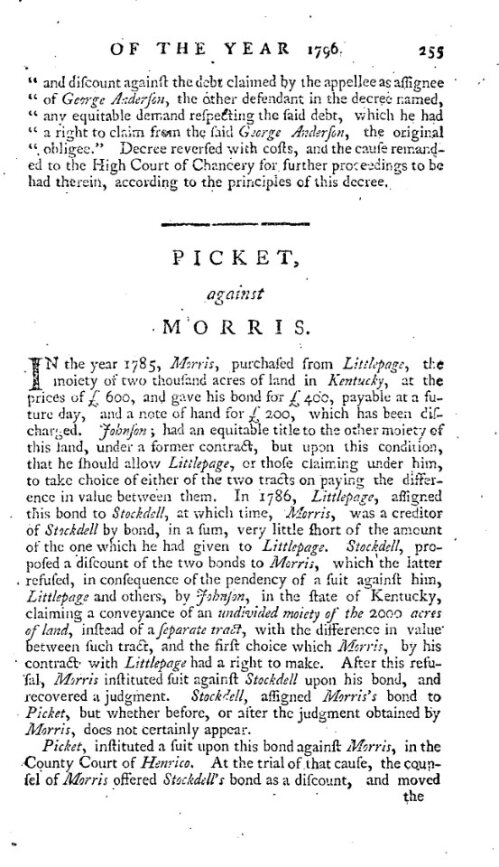
Picket v. Morris, 2 Va. (2 Wash.) 255 (1796),[1] was a case involving the discounting of a debt.
Background
In 1785, Morris bought a moiety, or a portion of land, in Kentucky from Littlepage. The transaction cost £600, to which Morris paid £400 as a bond, payable at a future date, and promissory note for £200 which at the time of litigation had been discharged. Another man, Johnson, had equitable title to the other moiety. Littlepage assigned the bond from Morris to Stockdell. However, Morris was also a creditor of Stockdell for a sum only a little short of the amount given to Stockdell by Littlepage. Stockdell proposed a discount of the two bonds to Morris, but he refused, because there was a case currently pending against him from Johnson who claimed an undivided moiety over all 2,000 acres of land. As a result, Morris instituted suit against Stockdell upon his bond, and recovered a judgment against him. Around the same time, Stockdell assigned his bond to Picket, although whether it was before or after the judgment was entered against him was a point of contention in this case. Picket then sued Morris, and the jury found for him. Morris moved for a new trial, which was refused, and then prayed for an injunction. He then filed his bill in the High Court of Chancery, praying to be relieved against this judgment, on the grounds that he should have been allowed to discount his debt at trial.
The Court's Decision
Upon hearing the case, Chancellor Wythe dissolved the injunction and perpetuated its residual effect. Additionally, Wythe decreed that Morris should assign to Picket the judgment he obtained against Stockdell. Finally, Wythe dismissed the case as to the claim against Littlepage. Picket appealed, and the Court of Appeals affirmed the Chancellor’s decree. The Court found that Morris's conduct did not amount to a waiver of his right to discount, so he should have been allowed to do so at trial. Furthermore, the fact that the lower court rejected his special verdict and refused him a new trial placed this case within the jurisdiction of the Court of Chancery, because a competent remedy could not be afforded anywhere else.
See also
References
- ↑ Bushrod Washington, Reports of Cases Argued and Determined in the Court of Appeals of Virginia,(Richmond: T. Nicolson, 1799), 2:255.